
Proximity Factor Tool – State Senate Bill 492
Major Changes to Florida’s Mitigation Banking Program Went Into Effect July 1, 2025
SB 492 was signed into law in 2025 and introduces significant updates to Florida’s wetland mitigation banking framework, particularly for projects regulated under F.S. 373. This legislation standardizes credit release schedules across the state, eliminates the requirement for cumulative impact analyses (CIA), and outlines a formal process for accessing out-of-service-area credits.
Whether you’re a landowner, consultant, developer, or agency, understanding these changes is essential to navigating your current and future mitigation needs.
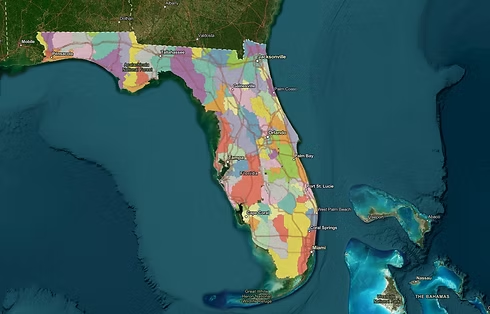
SB 492 brings sweeping updates to how mitigation is administered by the Florida Department of Environmental Protection (FDEP) and the state’s five water management districts. Key updates include:
Standardized Credit Release Schedule
- 30% of credits released upon recordation of the conservation easement and financial assurances
- 30% released after initial construction
- 20% released incrementally as interim performance criteria are met
- 20% released upon achieving final success criteria
Cumulative Impact Analysis No Longer Required
- Credit purchases within a bank’s permitted service area are now deemed to meet CIA requirements automatically.
- Credit purchases utilizing the SB 492 multiplier framework are considered to have satisfied the Cumulative Impact requirement under Section 373.414(8)(a), eliminating the need for separate cumulative impact analysis when using in-kind credits from outside the service area.
Formalized Process for Out-of-Basin Credit Use
- Applicants may use credits outside a service area if the mitigation service area lacks available in-kind credits.
- Requires a documented credit deficiency process and applies defined proximity multipliers.
- See below for a breakdown of the credit multiplier:
How does it work?
The Out-of-Basin credit tool calculates the number of mitigation credits needed when a project impacts areas outside a mitigation bank’s service area. Here’s a concise summary of how to use the tool:
01. Location Relative to Basin
- Service area of Mitigation Bank overlaps basin: Multiplier = 1.0
- One Basin away: Multiplier = 1.2
- Each additional Basin: Add 0.25
02. In-Kind vs. Out-of-Kind Replacement
- In-kind: Multiplier = 0
- Out-of-kind: Multiplier = 0.50
03. Calculate Multiplier
- Sum all multipliers to get the total proximity factor.
04. Determine Required Credits
Multiply the total proximity factor by the “as-if in-basin” credits required for the project.
The applicant must inform their agency reviewer (FDEP or WMD) that in-service-area credits may not be available and request to use out-of-service-area credits.
The agency has 7 business days to contact all mitigation banks with a service area that overlaps the project location.
The request asks for an accounting of available credits, including both in-kind and out-of-kind credits (excluding credits already reserved).
Mitigation banks have 15 business days to respond with their current available credit inventory.
If a bank fails to respond within that time, it is presumed no credits are available from that bank.
The agency then has 15 business days to review the responses and determine if enough appropriate in-service-area credits are available to meet the applicant’s mitigation requirement.
If no sufficient credits are available, the agency allows the applicant to reserve credits from an out-of-service-area bank.
A proximity multiplier is applied based on how far the mitigation bank is from the impact site.
The agency’s determination is valid for 6 months from the date of notification, but only for that specific pending permit application.